

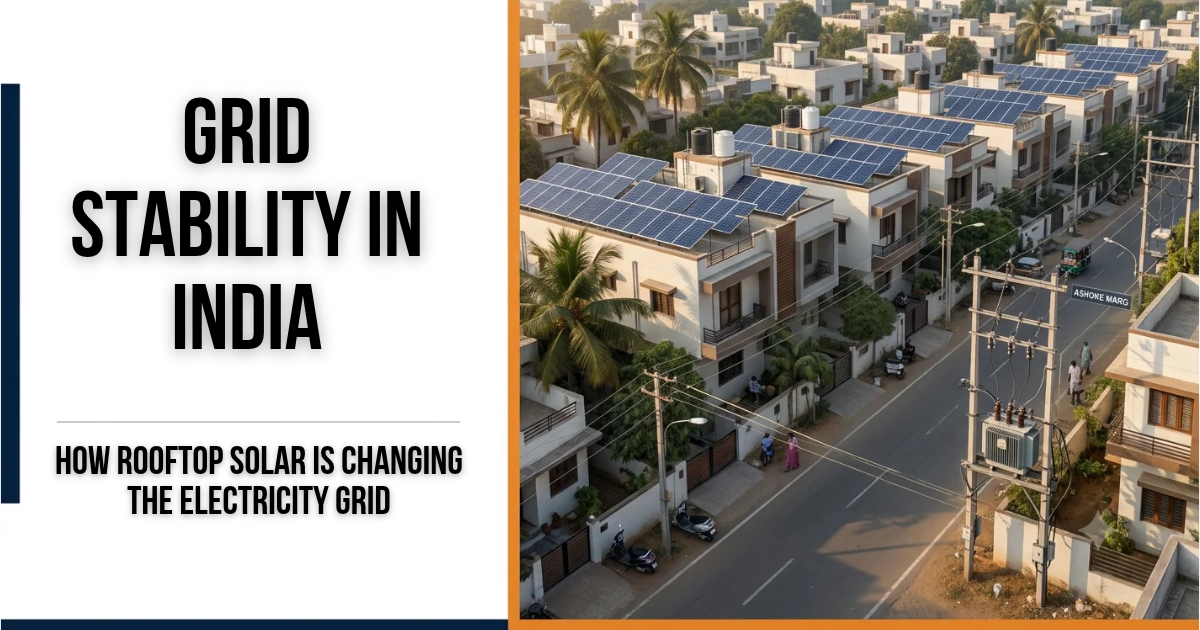
Grid Stability in India: Understanding the Impact of Rooftop Solar
India’s solar energy sector is growing rapidly. Rooftop solar is helping homes generate their own electricity and reduce their dependence on power supplied by the grid. However, this growth also brings new challenges for India’s electricity distribution network.
The electricity grid was traditionally designed to carry power in one direction, from generating stations to homes and businesses. With rooftop solar, electricity can now flow in both directions. When solar generation is higher than local consumption, surplus electricity can flow back into the distribution network.
This change creates challenges related to reverse power flow, transformer performance, voltage levels and the balance between electricity generation and demand. These challenges are also discussed in Pramit Brahmbhatt’s article on grid instability and rooftop solar in India.
Understanding these challenges is important as India continues to expand its renewable energy capacity. Maintaining grid stability will require the electricity network to adapt to changing patterns of power generation and consumption.
What Is Grid Stability?
Grid stability refers to the ability of an electricity system to maintain reliable operation when conditions change. Electricity generation and demand must remain balanced, while voltage and frequency stay within acceptable operating limits.
Electricity demand changes throughout the day. Homes use electricity for lighting, cooling and appliances, while businesses and industries have their own consumption patterns. Power generation must respond to these changing needs.
Traditionally, electricity flowed from large generating stations through transmission lines and substations before reaching consumers through distribution transformers.
The increasing use of rooftop solar changes this arrangement. Consumers can now generate electricity locally, use what they need and export surplus power to the grid.
Although this allows more renewable energy to be used, it also means that the distribution network must manage power flows that were not part of its original design.
How Rooftop Solar Is Changing India's Electricity Grid
Rooftop solar systems generate electricity during daylight hours. When a home or building produces more electricity than it consumes, the surplus may be exported to the local distribution network, subject to the applicable connection and metering arrangements.
This can be beneficial because electricity is generated close to where it is consumed. However, when many solar systems export electricity at the same time, local power flows can change significantly.
What Is Reverse Power Flow?
Reverse power flow occurs when electricity moves in the opposite direction from the traditional flow of power through a distribution network.
For example, during sunny hours, a group of homes may generate more electricity from rooftop solar than they collectively consume. The surplus electricity can flow back through the distribution transformer towards the higher-voltage network.
This is particularly relevant during periods of strong solar generation and relatively low local electricity demand, such as between 10 AM and 3 PM.
Distribution networks and their protection systems must be able to manage these changing conditions. Where infrastructure and settings are not suitable, reverse power flow can contribute to voltage problems, additional equipment stress and protection-system issues.
As rooftop solar adoption increases, managing these flows becomes an important part of renewable energy integration.
How Solar Generation Can Put Pressure on the Grid
The impact of solar generation extends beyond the direction in which electricity flows. Changes in generation and demand can also affect voltage levels, transformers and the operation of the wider power system.
Transformer Stress and Voltage Fluctuations
Distribution transformers help reduce electricity voltage to levels suitable for homes and businesses. They are an essential part of the electricity network.
When rooftop solar exports large amounts of electricity into a local network, transformers may experience reverse power flow and changing operating conditions.
Rising rooftop solar generation can affect the electricity grid in several ways:
- Additional heating: Electrical losses in transformer windings can increase heating, particularly when equipment operates under sustained high loading.
- Voltage rise: High solar injection can raise local voltage levels. If voltage exceeds permitted limits, solar inverters may disconnect to protect the system.
- Protection-system challenges: Protection relays designed around one-direction power flow may require suitable settings or upgrades to operate correctly under changing conditions.
- Inverter-related effects: Harmonics and other power-quality issues can add to equipment stress, depending on system conditions.
The article also cites research indicating that sustained transformer loading above 120% of its rated capacity can sharply increase failure risk. It refers to an NREL study that found a five-fold increase in rooftop solar could double the number of transformers experiencing overload for more than 10% of the year.
These findings highlight why local network capacity, transformer loading and appropriate protection systems matter as rooftop solar expands.
Understanding the Duck Curve
Another challenge comes from the difference between solar generation and electricity demand throughout the day.
The duck curve describes a pattern in which net electricity demand falls during periods of high solar generation and then rises quickly as solar output declines in the evening.
Net demand is the electricity demand that must be met by sources other than the solar generation being supplied at that time.
During sunny hours, solar power can supply a large share of electricity demand. As the sun sets, solar generation decreases, but households and businesses may continue to need substantial amounts of electricity.
Other power sources must then increase their output to meet the remaining demand.
India’s solar generation reached approximately 57 GW at midday in 2026. By 6 PM, non-solar generation sources had to increase output by approximately 15–20 GW within about three hours.
This rapid change creates operational challenges. Conventional power plants must adjust their output while the grid continues to meet electricity demand reliably.
The article estimates that the associated ramping requirements add approximately ₹12,000 crore annually in system costs.
The duck curve illustrates why adding solar capacity alone is not enough. The electricity system must also be able to manage changes in generation and demand throughout the day.
How Solar Generation Can Affect Electricity Prices
Changes in solar generation and electricity demand can also influence prices in electricity markets.
When solar generation is high and demand is relatively low, the available supply of electricity may exceed what the system can absorb at that time. Prices can fall sharply. When solar generation declines and demand remains high, prices may rise as other sources of electricity are needed.
An example from 3 May 2025 illustrates how electricity prices can change throughout the day:
- Power exchange prices fell to ₹1.85 per unit by 8 AM.
- Prices nearly reached zero around noon, when solar generation offered substantially more electricity than the grid could absorb.
- By the evening, prices for the same unit of electricity had risen to approximately ₹4–5.
These figures illustrate how the timing of electricity generation and consumption can influence market prices.
Price fluctuations alone do not establish that a grid is unstable. However, when considered alongside generation-demand mismatches and limitations in system flexibility, they can help illustrate the challenges of managing a power system with increasing solar generation.
Why Distribution Transformers Matter in India
Distribution transformers are a critical part of India’s electricity infrastructure. Their ability to operate reliably is important for maintaining electricity supply to homes, businesses and other consumers.
India has approximately 13 million distribution transformers, many of which serve residential areas. These transformers are commonly rated between 25 and 100 kVA and were generally designed around traditional one-way power flows.
In states with high solar adoption, including Gujarat, Maharashtra, Rajasthan and Tamil Nadu, some distribution transformers must manage reverse solar power flows during the day followed by higher electricity demand in the evening.
Repeated changes in operating conditions can contribute to thermal cycling, which may accelerate the ageing of transformer insulation.
The article highlights the potential financial impact on distribution companies, commonly known as DISCOMs:
- At an assumed 10% annual failure rate, approximately 1.3 million transformers would need replacement each year.
- A 100 kVA transformer may cost approximately ₹2.5–4 lakh, before accounting for outages and other associated costs.
- The article also cites national aggregate AT&C losses of around 16% and refers to 44 GW of unsigned power sale agreements (PSAs) as part of the wider financial pressure on the power sector.
These figures illustrate the scale of the infrastructure and financial challenges discussed in the article. Actual transformer failures, replacement requirements and costs vary by location, equipment condition and operating conditions.
For distribution companies, managing these challenges involves more than replacing equipment after it fails. Planning for changing power flows, monitoring transformer loading and adapting network protection can all be important parts of maintaining a reliable distribution network.
What Can Help Improve Grid Stability?
India’s renewable energy transition will require the electricity network to adapt as solar generation increases. Several approaches can help manage the changing relationship between electricity generation and demand.
Better Distribution Network Planning
Distribution networks need to account for rooftop solar generation as well as traditional electricity consumption. Understanding local solar adoption, transformer loading, voltage levels, and expected demand can help identify where upgrades or operational changes may be required.
Improved Monitoring and Protection
Monitoring voltage, power flows and equipment loading can help distribution companies identify problems earlier. Protection systems and inverter settings may also need to be appropriate for the operating conditions of networks with high solar penetration.
Greater Flexibility in Electricity Generation
The power system must be able to respond when solar generation rises or falls. More flexible generation and improved system operations can help balance supply and demand throughout the day.
Battery Energy Storage Systems
Battery energy storage systems (BESS) can store surplus electricity when it is available and release it when demand rises or solar generation falls, subject to system design and operating conditions.
Storage can therefore help manage the difference between daytime solar generation and evening electricity demand. Its effectiveness depends on factors such as capacity, charging and discharging schedules, grid connection and the wider operating requirements of the power system.
No single measure can address every grid challenge. A combination of suitable infrastructure, monitoring, operational flexibility and energy storage can help support the integration of renewable energy.
Conclusion: Balancing Solar Growth and Grid Stability
Rooftop solar is changing how electricity is generated and distributed in India. While it supports the transition towards renewable energy, increasing solar generation also introduces challenges related to reverse power flow, transformer loading, voltage management and changing electricity demand.
The duck curve highlights the difference between periods of strong solar generation and the evening demand that must be met by other sources. Distribution transformers and protection systems must also adapt to changing power flows.
Addressing these challenges requires the electricity network to evolve alongside renewable energy capacity. Better planning, suitable equipment, improved monitoring, flexible generation and energy storage can all contribute to a more adaptable power system.
As India continues to expand solar energy, maintaining grid stability will remain an important part of building a reliable and sustainable electricity network.
References
- Central Electricity Authority (CEA) — Power-sector statistics and distribution transformer data.
- Ember — Beyond Capacity: Why India’s Power System Must Get Flexible to Harness Its Solar Potential (January 2026).
- Down To Earth — Heatwaves, Rooftop Solar and Data Centres Force Rethink of India’s Power Sector Planning (May 2026).
- National Renewable Energy Laboratory (NREL) — Research on the impact of rooftop solar on distribution transformers.
This article is adapted from Sahaj Solar’s LinkedIn article, “The Grid Instability Crisis: How Rooftop Solar Is Straining India’s Distribution Network.”


