


India’s Residential Solar Market Is Growing
Solar energy in India is no longer limited to large projects and commercial installations. More households are now turning to rooftop solar to generate their own electricity and reduce their dependence on conventional power sources.
This shift has helped residential rooftop solar become an important part of India’s growing renewable energy landscape. Over the past few years, installations have increased steadily, supported by falling technology costs, greater awareness and stronger government support.
A major push has come from the PM Surya Ghar Muft Bijli Yojana, which aims to make rooftop solar more accessible to households across the country. With financial support for residential installations, the scheme has encouraged more families to consider solar for their homes.
The growth is significant not only because of the number of systems being installed, but also because it shows a broader change in how Indian households are looking at energy. Rooftop solar is increasingly becoming a practical option for homes that want to generate clean electricity while taking greater control of their energy consumption.
So, how quickly is India’s residential solar market actually growing? And what role has PM Surya Ghar played in this change?
Let’s look at the numbers.
India’s Residential Rooftop Solar Growth: What the Numbers Show
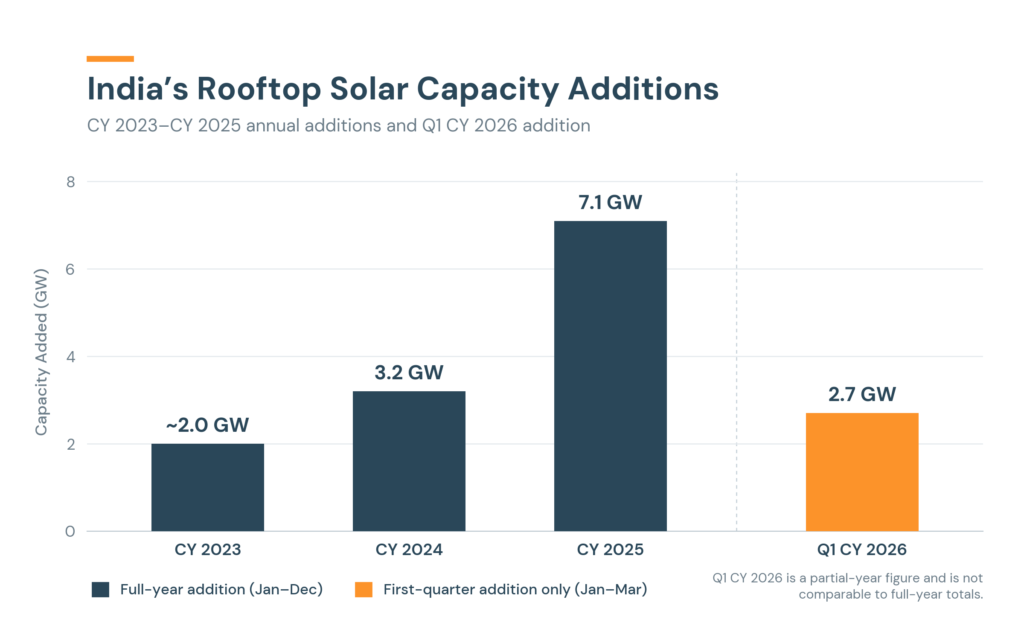
The growth of rooftop solar in India has been remarkably fast. In just one year, annual rooftop solar additions more than doubled, showing how quickly rooftop solar is becoming part of the country’s energy landscape
In calendar year 2024, India added 3.2 GW of rooftop solar capacity. By 2025, that figure had risen to 7.1 GW — a 122% year-on-year increase.
The momentum continued into 2026. By the first quarter of the year, residential installations accounted for 82% of all new rooftop solar additions. India added 2.7 GW of rooftop solar capacity in Q1 2026 alone.
By June 2026, India’s cumulative rooftop solar capacity had crossed 30 GW.
Growth Trajectory: Year by Year
3. Things to Consider Before Installation of Solar Panels
Roof Condition & Orientation
- Your roof should be structurally sound
- South-facing roofs (in the Northern Hemisphere) get the most sunlight
- Minimal shading from trees or buildings is ideal
Energy Needs
- Calculate your average monthly electricity use
- This helps determine how large your solar panel system needs to be
Types of Solar Panels
Choose the best type based on efficiency, cost, and appearance:
- Monocrystalline – High efficiency, higher cost
- Polycrystalline – Budget-friendly, less efficient
- Thin-film – Flexible, less efficient, easy to install
Local Permits and Incentives
Check local building codes, zoning laws, and apply for:
- Net metering agreements
- Government subsidies or tax credits
4. Tools and Materials Needed
To install solar panels at home, you’ll need:
- Solar panels (based on your energy needs)
- Inverter (converts DC to AC)
- Mounting racks or brackets
- Wiring and connectors
- Circuit breakers and junction boxes
- Safety gear (gloves, helmet, harness)
- Drill and standard power tools
5. Step-by-Step Guide to Install Solar Panels
Step 1: Plan the System
- Decide on the system size (e.g., 3kW, 5kW)
- Choose the right solar panel type and inverter
- Consider adding batteries if going off-grid
Step 2: Choose a Mounting Location
- Rooftop or ground mount depending on space and sunlight
- Make sure the area is not shaded during daylight hours
- Roof angle should ideally match your region’s latitude
Step 3: Install the Mounting Structure
- Firmly attach the metal mounting frame to your roof using strong bolts for a stable foundation.
- Make sure it’s tilted properly to capture maximum sunlight
- Use weather-resistant materials for longer durability
Step 4: Mount the Solar Panels
- Fix the panels onto the mounting structure
- Use nuts and bolts to secure them
- Make sure panels are aligned and angled correctly
Step 5: Electrical Wiring
- Connect each panel using MC4 connectors
- Follow the series or parallel configuration based on your design
- Route wires to the inverter using a conduit
Step 6: Install the Inverter
- Mount the inverter near your main power panel
- Connect solar panel wires to the inverter
- For on-grid systems, connect the inverter to the grid input
Step 7: Connect to the Main Power Supply
- Link the inverter’s output to your home’s main electrical board to supply power throughout the house
- Install proper circuit breakers to protect the system
Step 8: Grounding and Safety Checks
- Ground all components to prevent electric shocks
- Check for loose wires, short circuits, or leaks
- Use a multimeter to test voltage output
Step 9: Monitor the System
- Turn on the inverter and check the system status
- Use a solar monitoring app to track performance
- Regularly clean and inspect the panels
6. Cost of Installing Solar Panels at Home
|
System Size
|
Estimated Cost (INR)
|
Power Output
|
|---|---|---|
|
1 kW
|
₹60,000 – ₹75,000
|
4 units / day
|
|
3 kW
|
₹1,50,000 – ₹2,00,000
|
12 units / day
|
|
5 kW
|
₹2,50,000 – ₹3,00,000
|
20 units/day
|
7.Should You Add Solar Batteries?
8. Maintenance Tips After Installation Solar Panels
- Clean panels every 2–3 months
- Check inverter for error messages
- Trim nearby trees to prevent shading
- Schedule annual inspection
9. Common Mistakes to Avoid
- Ignoring local rules or permits
- Skipping roof inspection
- Using poor-quality panels or inverters
- DIY installation without proper knowledge
Conclusion
Installing solar panels at home is not just about saving money it’s about building a cleaner, more self-reliant future. With careful planning and the right equipment, you can install a solar panel system that powers your home for 25+ years.
If you’re unsure about doing it yourself, hire a certified solar installer to make the process easier and safer.


